Proëm
As the biological sciences have progressed, and our knowledge of the human body has become more comprehensive, it has become clear that sex is not a binary. Similarly, as our understanding of social phenomena has become increasingly divorced from old prejudices – though much work is yet to be done – a theory of gender has been developed that separates sex from gender. It has similarly become clear that gender is non-binary as well. In this essay, the author will endeavour to develop a vocabulary that more accurately expresses her understanding of sex and its consequents, as a preliminary groundwork for future gender-theorising. A corollary effect should, hopefully, be to delegitimise the current unconsidered understandings of sex and gender, which have been known to be erroneous for too long to excuse the current state of the general populace’s understanding.
What is sex?
Sex is a collection of biological phenomena found in humans, as well as in many other living beings. This discussion deals with human sex unless otherwise indicated. Efforts to reduce sex to gamete size, gonads, chromosomes, or even the absence or presence of a phallus, largely in order to uphold the supposed binary of sex, have all been discovered to give an incomplete and imperfect understanding of the phenomenon. Sex should instead be considered as a cluster, or cloud, of interrelated phenomena – sexed characteristics – which, when expressed in a large group of individuals, will constitute a bimodal distribution of said individuals; there are two large clusters which constitute the normative “male” and “female” sexes, though many individuals fall outside these clusters.
Sex is constructed from mutable and immutable, apparent and unapparent characteristics: chromosomes cannot be changed, while the endocrine system is changed very easily; chromosomes are unapparent during the sexing of newborns, whereas the absence or presence of a phallus is apparent, and thus remains the foundation of the assignation of sex at birth. Sex appears to be present in the neurological system of the body. Additionally, neurological expressions of sex appear to be among the immutable sexual characteristics. The mismatch between a trans person’s neurological expressions of sex and gendered existence is, in a sense, the cause of gender dysphoria.
It should be noted that, due to the current lack of information about intersexes – particularly intersexes that are imperceptible to the naked eye of the sexing doctor, i.e., intersexes that do not make themselves apparent at birth – and the complexity of the development of sexed beings, human sex is not yet an object of entirely accurate knowledge. Neurological expressions of sex, for example, are the object of self-knowledge, and can only to a certain extent be observed scientifically, that is, by non-subjective means. This is not necessarily a bad thing, as the objective knowledge of neurological sex could be used in the eugenicist project of trans extermination.
What is gender?
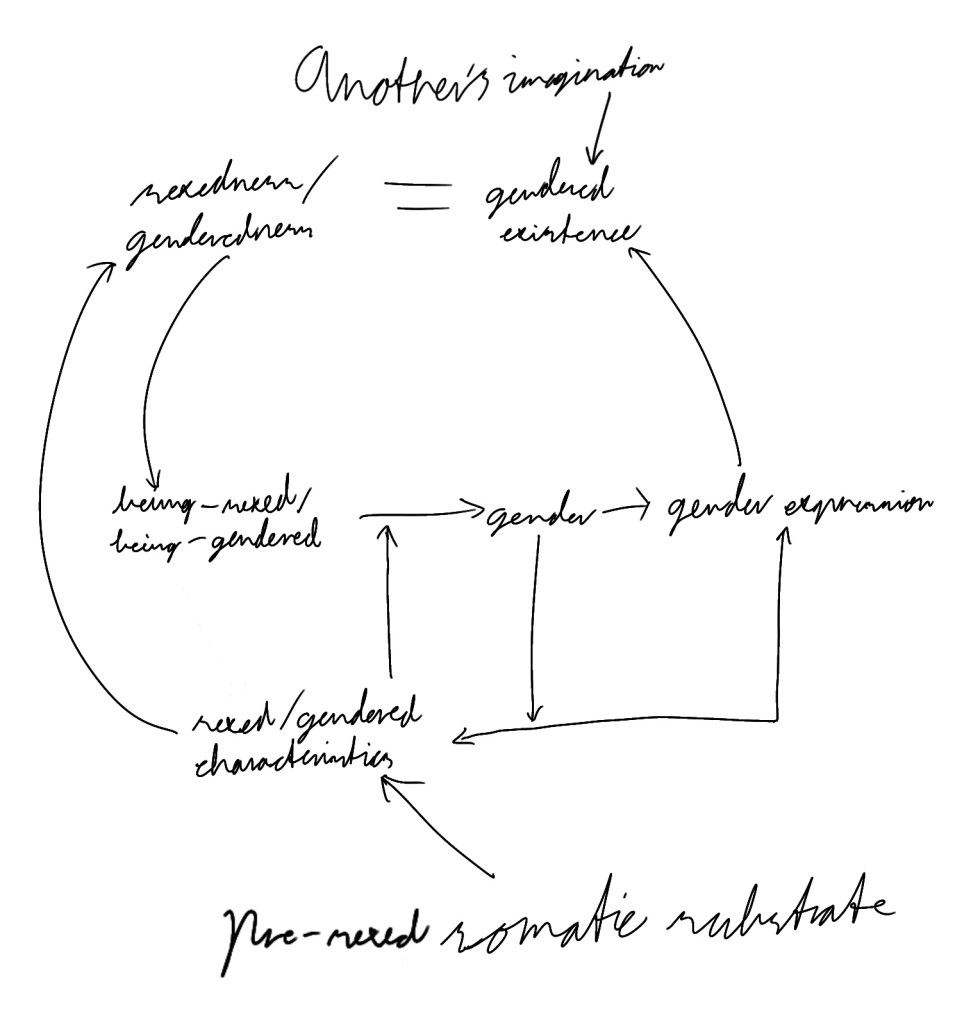
Neurological expressions of sex are the biological precedent of gender, which is a mental phenomenon. As a person grows up, they are inundated by gendered existences, both of others and their own. The interaction between societal standards of gendered existence and neurological expressions of sex is called gender. Just as sexuality is the mental phenomenon of perceiving others’ gendered existence, gender is the mental phenomenon arising from one’s perception of the actualisation of others’ perceptions of one’s own gendered existence – that is, gender arises in response to the other’s interactions with the gendered self; sexuality initiates the process of subjectifying oneself, of perceiving others for oneself, while gender initiates that of objectifying oneself, of being perceived for oneself.
Gendered existence is the gender-in-another of an individual. If gender is a person’s response to their being-gendered, then gendered existence is their particular genderedness, the cause of their particular being-gendered. In practice, this means that gendered existence is the assumptions about an individual’s gender that are formed in the minds of others based on culturally conditioned aesthetic criteria. These criteria are individual; a person’s gendered existence is neither constant, nor, all things being the same, will every other perceive it in the same way. This means that a person might pass as a man or woman to some people at some times, but not others at other times, despite their gender expression and sexed characteristics remaining identical.
The relationship between genderedness and sexedness is complicated and vague. It is possible that they should be considered a single phenomenon, at least in most cases. And yet it seems apparent that wearing-a-skirt is not a sexed characteristic in the same manner as having-a-penis. The difference may lie, to some degree, in the sexedness of a characteristic being assumed – however falsely – to be unchangeable and objective, whereas the genderedness of a characteristic is simpler to change in the imagination of observers. If this is so, it seems one must admit that pronouns can be sexed in the minds of the people who believe that pronouns cannot be changed, seeing as their stated belief is that gendered pronouns are, somehow, “biological,” whatever this might mean.
What is a trans person?
If the defining characteristic of the human being is its relationship to its being, it seems reasonable to conclude that the defining characteristic of the transgender being is its relationship to its being-gendered. The being-gendered of a trans person inspires their gender, and thus their gender expression, and this, in turn, influences their gendered existence. The trans person seeks to change their being-gendered in a fundamental way, unlike the cis person, who does not feel a desire to change their being-gendered. This difference in desire is explained the cis person’s being-gendered being in accordance with their gender, whereas, for the trans person, this is not the case.
The mental phenomena of both dysphoria and euphoria stem from the relationship between the being-gendered of an individual and their gender. In order to solve the problem of dysphoric reactions to their being-gendered, seeing as the cause of gender appears to be immutable, the most efficient way forward is to transition. Transition is the changing of one’s gendered existence from one type to another, whether medically or non-medically. Medical transition is the changing of sexual characteristics through medical means, such as surgeries or hormone replacement therapy, which will, in turn, change the gendered existence of the individual. Non-medical forms of transition can include asking people to use new pronouns for oneself, or changing one’s gender expression.
Due to the limited perspective of the cis population, genders that do not conform with normative types of gendered existence, are often discriminated against to a greater degree, or simply assumed away. Gendered beings that have gendered existences that induce non-normative discordances – such as in the case of the non-passing binary trans person – are also discriminated against to a greater degree. This is because in being-non-passing, the trans person is apparent, and thus experienced as a threat to cis standards of sex and gender. When a passing trans person makes themself apparent of their own free will, they are also subject to increased discrimination. That is, their conditional cissexual privilege is revoked, and their gender is delegitimised. Non-binary people, though they can pass as cis, do not have the privilege of both passing as cis and having their gender respected at the same time to the same degree as binary trans people.
In being-apparently-trans, cis people see an implicit threat to the established norms and hierarchies of gender, which may be called “patriarchy.” If sex is no longer seen as an inexorable Fate, but rather something malleable and surpassable, the door is opened to “gender anarchy” and the destruction of the patriarchal family. This is, of course, rather ridiculous, as few would choose to change their sex even if it were commonly acceptable: it is a simple retread of old anxieties surrounding homosexuality, which have not come to pass even as homosexual relationships have become increasingly accepted. Being-apparently-trans alienates the trans person from their unsupportive peers, whereas being-unapparently-trans alienates the trans person from everyone, though to a much lesser degree. On account of the prevalence and violent impulses of unsupportive peers, it is generally preferable to be unapparently trans, though it seems important to be apparently trans among safe people, so as to not suffer the psychological effects of isolation.
The transgender being, though defined by its peculiar relationship to its being-gendered, does not necessarily know that it is defined by this relationship. This lack of self-knowledge both increases and decreases the distress as experienced by the trans person; it increases the distress by making the cause of the distress unapparent to the subject, but it decreased the distress by not offering a way out of the suffering. The trans person who has become aware of their being-trans, but who is not allowed to transition due to societal pressures, is akin to Tantalus, seeing the objects of their desire in front of them, but unable to reach and obtain them.
Final notes
The most obvious relationships between the various influences on and aspects of the transgender being have been discussed in a preliminary manner, though much reading, discussion, and thinking remains to be done in order to refine the system which has been described. It is also important to avoid the solipsism that currently characterises the theory through continued discussion with trans people whose experiences differ markedly from the author’s, as she has at present mainly relied on discussions with other white trans people living in the global north, only a small number of whom were non-binary.

